
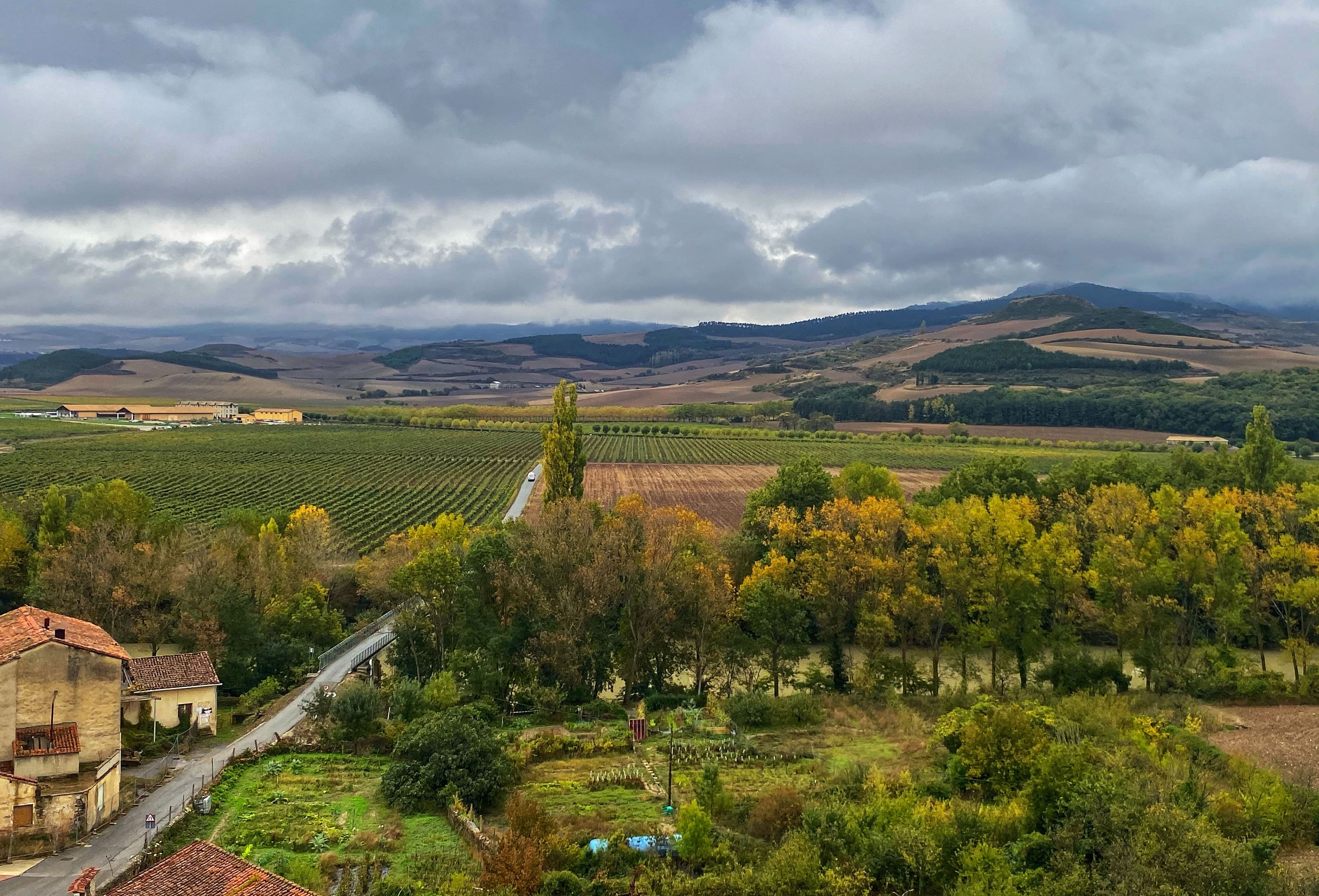
In the 19th century there were over 6,000 hectares of vineyards surrounding Pamplona, and over 50,000 in Navarra as a whole. The city that is known for the running of the bulls was also known for its overflowing wine production.
The pilgrim’s route to Santiago de Compostela passes straight through Navarra and Pamplona, and pilgrims would bring vines with them. A great diversity of grape varieties were planted in Navarra and many native ones were born. The pilgrims also took wine from Navarra with them and it grew into a popular trade route. It was even said that the French had a penchant for Navarra rosado (rosé).
Perhaps because of the open trade route, Navarra was one of Spain’s first wine regions to be hit – and devastated – by phylloxera. The fatal louse wiped out most of the wine production not only in Pamplona, but throughout Navarra — killing over 95% of the vineyards. Navarra never really recovered and there are just 10,500 hectares planted today, only 110 of which are in Pamplona. And they all belong to one estate, Bodega Otazu.
Bodega Otazu: a historic Pago in northern Navarra
With a history stretching back to the 11th century, the historic village of Otazu is actually split between two neighbouring properties: the estate of Señorío de Otazu and the estate of Señorío de Eriete (each owned by the respective Señors during the Middle Ages).
Each of the conjoining estates has its own palace and monastery with vineyards stretching between them and the winery conveniently located right in the middle. As the only winery in Pamplona, Bodega Otazu doesn’t have any neighbours but that’s not the reason why this has merited the status of a Vino de Pago. Otazu and this region have their own distinctive mesoclimate, making the winery quite different from any of its fellow producers in Navarra.
At the southern end of Navarra, you have desert-like conditions with the lunar landscape of the Bardenas Reales, whereas the northern tip almost touches the humid maritime forests of San Sebastian and is impacted by the Pyrenees. In the northern half of the region lies the Otazu estate, the coolest region of Navarra and a bit of an anomaly in Spain.
“We are the northernmost vineyard in Spain to produce red wine,” explains winemaker José Luis Ruiz. “Here we have a very Atlantic influence — we are only 60 km from the sea! We have a lot more rain than anywhere else in Navarra and much cooler temperatures.”
Finding mesoclimates in Navarra for Bordeaux varieties
Despite the higher rainfall and cooler temperatures, the Pago of Otazu is able to ripen even Cabernet Sauvignon. Why? Warming river gravels in the soil and a rain shadow effect cast by the chain of mountains and high hills that surround the Pago and fend off the worst of the wet Atlantic weather fronts.
As with much of Navarra, the varieties that have been planted most in recent decades are the internationally famous ‘Bordeaux varieties’ of Cabernet Sauvignon and Merlot, as well as local Tempranillo, and especially Chardonnay.
“We have a similar climate to Bordeaux, and we are on the very route that the pilgrims took from France through Spain to Santiago de Compostela, so it makes sense that these varieties arrived with the pilgrims, and thrived here!” explains José Luis.
The clay soils towards the higher part of the hills is where they’ve found the best sites for Merlot, and their Cabernet Sauvignon grows in the river gravels below. In the future, Bodega Otazu plans to plant Cabernet Franc too, as well as working with several different clones of Tempranillo to find the best ‘local variety’ suitable for this cooler climate.
Navarra as a whole has become well known for its international grape varieties rather than ‘Spanish’ ones. This has been condemned — wrongly, in my opinion — by some stalwart critics. Many of these Bordeaux varieties first arrived over 100 years ago, which rather renders the term ‘new’ redundant. There are records of Cabernet Franc being produced in Navarra as far back as the 14th century — before many of the New World’s most famous Cabernet regions had even been ‘discovered’. If Napa can make a name with Cabernet Sauvignon, so can Navarra, I would argue.
One of the ‘newer’ varieties to arrive in Navarra is Chardonnay, which first stepped into the limelight about 20 years ago.“This is also one of the only places in Spain where you have temperatures cool enough and enough rain to make good Chardonnay,” says José Luis, who believes the potential for Chardonnay here makes it one of the top varieties.
The fresh quality of not only Otazu’s Chardonnay but also their red Bordeaux varieties is undeniable, and this cooler climate is evident not only in the wines but also in their harvest dates… Bodega Otazu is often still harvesting in November!
But cooler climate styles of Bordeaux varieties is not the only trick that this Pago has up its sleeve.
Rediscovering 19th century Pamplona wines & Navarra natives
Although Bodega Otazu’s modern vineyards were all planted in the last 30 years (since the current owners bought the abandoned property in 1991), they are on a mission to recover some of the ancient viticultural traditions of the zone.
“We’re trying to recover some native varieties that we lost in the 19th century,” José Luis explains with a childlike twinkle in his eye. “We have old documents from the Middle Ages that show that here in Navarra there were lots of different native varieties, and they were all lost after phylloxera came. We’ve been working on recovering these native vines, such as Berues and Morate, which we managed to grow from the couple of vines that were kept in a library of ancient Spanish varieties in Jerez.”
José Luis and his winemaking team have recovered these ancient Navarra vines and brought them back to their homeland, planting them in their own experimental vineyard. They have also been foraging in the mountainsides surrounding the property, where they have found many wild vines, which they are in the process of identifying. Bodega Otazu currently has six unidentified varieties that they have replanted in their vineyard and which so far appear to be native and unknown anywhere else.
“We also want to recover our heritage, and make the kind of wines that were made back in the 19th century,” José Luis enthuses.
Visiting Bodega Otazu: a blend of contemporary and ancient
This exciting project to rediscover native varieties is just one of the ways in which this impressive winery is paying homage to the past and bringing the experience into the present day. A visit to Bodega Otazu itself is an experience in which you have one foot firmly in the past, and another in the most remarkable world of contemporary art.
The family that own the winery and both old estates, both Señoríos, have lovingly restored the 16th century palace, the winery and its 12th century chapel at Señorío de Otazu and are in the process of restoring the historic estate at Señorío de Eriete. All the while, the estate has one of the world’s most extraordinary contemporary art exhibitions interwoven between the landscapes and buildings.
With over 700 pieces of art in the private collection, there’s no lack of directions in which to look. Sculptures not only adorn the winery grounds, but are displayed throughout the historic village, making a stroll through the Pago a fascinating journey of discovery. Within the winery itself, there are several levels of art exhibitions which range from sensory light displays to audiovisual works.
View this post on Instagram
Then, much like the famous wine label display in Chateau Mouton-Rothschild in Bordeaux, there is an entire gallery dedicated to the development of their unique wine labels in collaboration with contemporary artists. The largest scale label artwork is the futuristic Vitral project, which was started with the 2013 vintage, in collaboration with the Venezuelan artist Carlos Cruz-Diez, who was considered by many as one of the most innovative artists of this century. Cruz-Diez, who passed away in July this year, was renowned for rethinking the concept of colour and you can see his impressive chromosaturation installation in the cellar of the winery.
However, the art work that keeps giving is the Vitral project, in which wine collectors of this special edition release will also receive a unique piece of Cruz-Diez’s art each vintage until 2042. It’s quite a remarkable project and one that shows not only the owners’ passion for combining art with wine, but their long-term vision for the importance of both worlds – restoring this ancient Pago in Navarra with colourful flair.
Navarra at a glance: Fast Facts
- Navarra DO created in 1933
- Climate ranges from maritime to mediterranean
- Wide diversity of soils including marl, sand, clay, alluvial, loam, river gravel and brown-limestone
- Altitude: 300m to 650m above sea level
- Rainfall: ranges from 350mm per year (in Ribera Baja) to 670mm (in Valdizarbe)
- Wine production: 60% red wine, 30% rose wine, 10% white wine
- Most planted grape varieties in Navarra: Tempranillo, Garnacha, Cabernet Sauvignon, Merlot, Chardonnay
Wine regions of Navarra
- Cooler, maritime sub-regions towards northern Navarra include Tierra Estella, Valdizarbe, Baja Montaña
- Ribera Alta is a more continental sub-region with more extreme temperature differences
- Ribera Baja has a more moderate Mediterranean influence
Wine tasting notes from Bodega Otazu
Pago de Otazu Chardonnay 2016
This is quite a rich Chardonnay but it also has fresh and vibrant notes of lemon curd and orchard fruit. A bright acidity underpins the wine, which has added complexity and structure from time in the barrel.
Otazu Chardonnay 2018
This youthful Chardonnay is focused on fresh fruit expression with refreshing aromas of apple and dried chamomile.
Otazu 2018 (Cabernet Sauvignon, Merlot & Tempranillo blend)
With about a third of each variety in the blend, this wine has plenty of spice and fruit although the finish is fresh and lively. A great wine to drink on a warm autumn evening.
Otazu Merlot Rosé
This is the only 100% Merlot rosé made in Navarra and it boasts lively red fruit, spice and floral notes. Vibrant and refreshing.
Pago de Otazo 2015
This Merlot-dominant blend has 20% Cabernet Sauvignon and 10% Tempranillo, which results in a rich and mouth-filling wine which still has an attractive freshness on the finish.
Altar 2008
This is Bodega Otazu’s top wine for now, and it is a rich and complex single-variety Cabernet Sauvignon, which feels much younger than 11 years old! Leafy notes and slightly stalky tannins keep this bright and lively with great acidity to balance out the concentration of fruit and time in the barrel.
Unnamed Merlot…
I tasted a very exciting sample of a 2018 vintage Merlot which has yet to be named. Coming from a plot higher in the hills, it is a grippy Merlot with a lot of texture and an attractive dark style. Looking forward to seeing where this wine goes!
 If you are planning a visit to Navarra and Spain, my visit was in association with Wine Paths: offering luxury and exclusive wine tours and experiences in wine regions around the world. You can book your own Navarra wine experience and visit to Bodega Otazu online here.
